Flatbreads & Griddle · Chinese home cooking
Layered Home-Style Flatbread (Laobing)
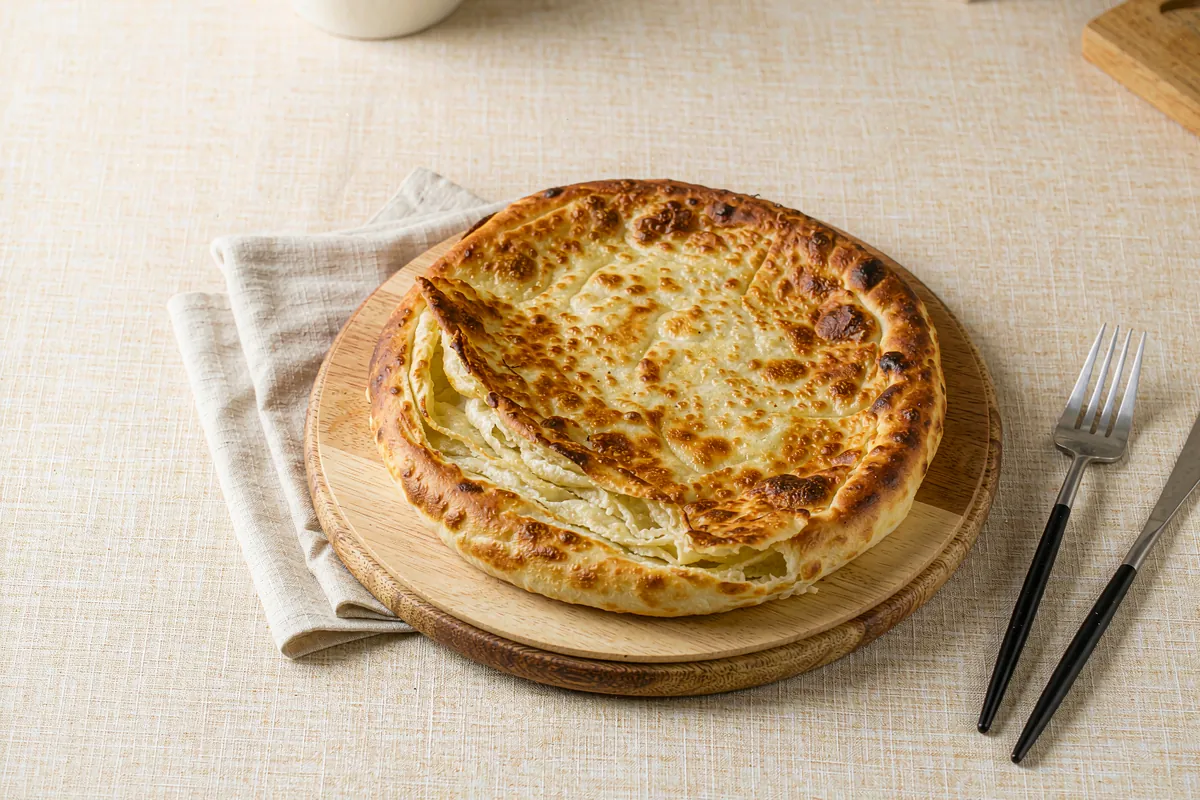
A soft, oil-layered dough is folded, rested twice and slowly griddled until the outside turns crisp and bronzed while the inside steams into tender, peelable sheets.
About this dish
Laobing is the bread home cooks make when there is no time for yeast: flour, warm water and a rest do the work. The dough should feel as soft as a cheek and keep a faint fingerprint when poked, so it stretches thin without tearing. Folding an oiled sheet into layers traps steam; on the hot griddle you hear a crackle and smell toasted wheat, not scorching. Watch for pale amber blisters rising across the surface, then deeper bronze at the rim. Eat it warm, torn by hand.
Before you start
Equipment: Griddle. Tap the ingredient checkboxes as you go.
Method
7 steps · tick each one off as you finish it.
Mix and knead
Stir the 240 ml warm water and salt into the flour until a shaggy mass forms, about 2 minutes. Knead in the bowl for 5 minutes until supple and slightly tacky; it should slowly spring back when pressed but not stick to your fingers.
First rest
Cover with a damp cloth and rest 30 minutes at room temperature. The dough will slacken and look slightly puffed; a finger pressed 1 cm deep should leave a dent that fills back only slowly.
Fold in the layers
Divide into 4 balls of about 160 g. Roll one to a 26 cm round, brush with 1/2 tbsp oil and a quarter of the scallions and sesame oil, then fold into thirds like a letter and roll up into a coil.
Second rest
Set the coils seam-side down, cover and rest 15 minutes. This second rest relaxes the folded gluten so the bread puffs into distinct leaves instead of a dense slab; the coils should feel soft and spread slightly.
Roll out
Flatten each coil into a 20 cm disc about 8 mm thick, thicker than a scallion pancake. Dust the board with only a whisper of flour so the surface stays dry; visible pale streaks of oil mark where the layers will separate.
Griddle
Heat a dry cast-iron griddle over medium-low for 4 minutes until a drop of water dances then evaporates. Lay on one disc, cook 3 minutes until the underside is nut-brown with blisters, flip, brush 1 tsp oil on top and cook 3 minutes more.
Finish and tear
Turn once more for 1 minute if the centre feels doughy when pressed, then rest on a rack 3 minutes. Pull the loaf apart at the seam; it should open into soft, steaming sheets with a crisp, bronze outer shell.
Tips that matter
- A second rest is not optional here; it is what lets the folded dough open into leaves rather than a dense slab.
- Cook over medium-low, not high; a slower griddle dries the layers into steam pockets before the outside can scorch.
Easy variations
- Brush the oiled sheet with 1 tbsp miso mixed into 1 tsp oil for a salty, deeply browned version.
- Add 60 g grated carrot and 1 tsp cumin to the filling for a slightly sweet, earthy loaf.
Questions that come up
My laobing stayed hard in the middle. What went wrong?
The disc was probably rolled too thick or the heat too high. Aim for 8 mm and medium-low, and give it a final 1-minute turn if the centre still feels doughy when pressed.
Can I make the dough a day ahead?
Yes, rest it covered in the fridge overnight, then bring it back to room temperature for 30 minutes before folding; cold dough tears instead of stretching.
Nutrition, roughly
| Energy | 380 kcal |
|---|---|
| Protein | 9 g |
| Carbohydrate | 58 g |
| Fat | 12 g |
Estimated per serving from standard ingredients, rounded. Treat it as a guide, not clinical data.
Flour, Water and Rest: Working with Wheat Dough
The three states of a simple dough, how hydration changes them, and why resting time is an ingredient rather than a pause.