Congee, Porridge & Oats · Chinese home cooking
Salmon and Vegetable Congee
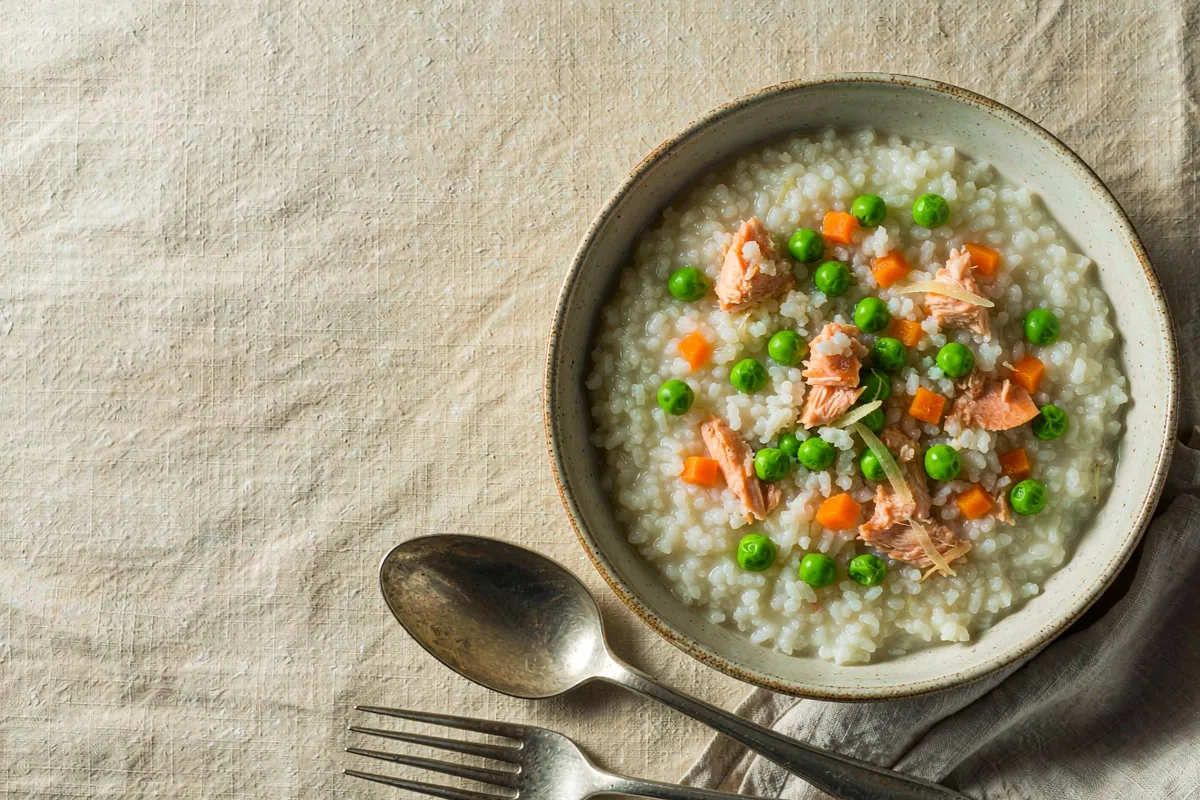
Flaked salmon is folded into a ginger-scented rice congee at the very end, so it stays in large moist pieces; peas and carrot add colour and a faint sweetness without turning the broth heavy.
About this dish
Fish and congee are a timing problem more than a flavour one. Salmon turns opaque in two minutes, so it belongs at the end, off the boil, where the pot's residual heat poaches it gently. Carrot and peas do the opposite job: they go in early enough to lose their raw edge and lend the rice sweetness. First comes the smell of ginger in steam, then the faint orange oil rising where the flakes sit. Keep them large; hard stirring turns the bowl pink and pasty.
Before you start
Equipment: Pot. Tap the ingredient checkboxes as you go.
Method
7 steps · tick each one off as you finish it.
Season the salmon
Off the heat, toss 250 g salmon chunks with 1 tbsp soy sauce and 1 tsp sesame oil for about 2 minutes. You will see it is ready when the surfaces look slick and the fish still holds firm, clean edges.
Start the base
Warm 1 tbsp oil and 15 g ginger threads in a pot over medium heat for 60 seconds, then add 1800 ml cold water and 200 g rice. Ready once the ginger smells sharp and the grains begin to drift.
Boil then drop
Raise the heat to high for 10 minutes, then lower it and simmer the 200 g rice with the lid ajar for 20 minutes. You will know it is right when the grains have split and the broth coats the back of a spoon.
Cook the vegetables
Add 100 g diced carrot and 1/2 tsp salt over low heat for 8 minutes, then stir in 80 g peas for 2 minutes more. Move on when the carrot yields to a spoon and the peas turn a bright, flat green.
Poach the salmon
Take the pot off the heat, lay 250 g salmon on the surface and cover for 5 minutes. You can tell it is done when the chunks have turned opaque coral and flake along their seams without any translucent centre.
Fold gently
Still off the heat, break the 250 g salmon into large flakes with a fork and fold once through the congee over 1 minute. It has had enough when the flakes stay in distinct pieces and the broth takes on a faint orange sheen.
Serve
Off the heat, ladle into four bowls and scatter 60 g scallion greens on top within 2 minutes. It is right when the greens stay dry and bright while a thin line of oil rings the edge of each bowl.
Tips that matter
- Add the salmon only after the heat is off; a live simmer tightens the protein and gives you dry, chalky flakes instead of soft ones.
- If using frozen peas, thaw them first, since ice-cold peas drop the pot temperature and leave the carrot undercooked.
Easy variations
- Swap the salmon for 250 g firm white fish and add 1 tbsp of dried shrimp with the ginger for a brinier broth.
- Stir 60 g sweetcorn in with the peas for a sweeter, yellow-flecked bowl that children tend to pick at first.
Questions that come up
Why did the salmon fall apart into threads?
It was stirred too early or too often. Poach the chunks undisturbed on the surface for the full 5 minutes, then fold just once; the pieces should stay the size of a thumbnail.
Can I use cooked salmon?
Yes. Skip the 5-minute poach and fold 200 g flaked cooked salmon in off the heat just before serving, letting the bowls' warmth take the chill off without cooking it again.
Nutrition, roughly
| Energy | 345 kcal |
|---|---|
| Protein | 20 g |
| Carbohydrate | 45 g |
| Fat | 10 g |
Estimated per serving from standard ingredients, rounded. Treat it as a guide, not clinical data.
A Staple Cupboard That Earns Its Space
A short list of grains, flours and dried noodles, how long they actually keep, and what each one can become once it reaches the pan.