Bread, Toast & Pizza · American home cooking
Everyday Sandwich Loaf
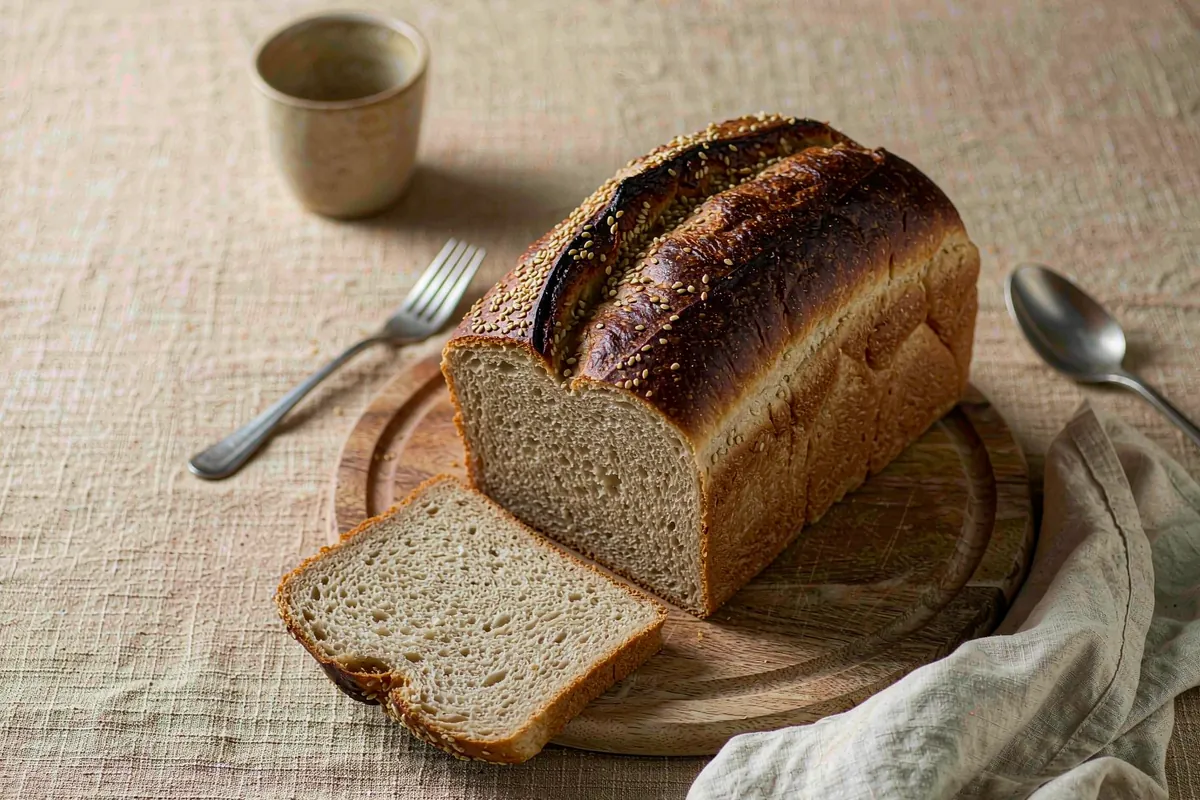
A soft, fine-crumbed white loaf baked in a tin for even slices, with a pale golden crust that stays tender enough for weekday sandwiches and toast for nearly a week.
About this dish
A sandwich loaf is built for the knife, not the tearing hand, so the dough is enriched with milk and butter and kept fairly stiff. Kneading develops just enough gluten to hold a uniform, close crumb that will not shred under a layer of filling. You will hear the dough change from a wet slap to a soft, quiet thud. When doubled, it should feel pillowy and hold a slow fingerprint when pressed. The baked loaf smells of warm milk and toasted wheat.
Before you start
Equipment: Oven. Tap the ingredient checkboxes as you go.
Method
7 steps · tick each one off as you finish it.
Mix the dough
Whisk 500 g flour, 7 g yeast, 1 tbsp sugar and 1.5 tsp salt in a bowl. Pour in 300 ml milk and add 40 g softened butter, then stir until a shaggy dough forms with no dry flour left, about 2 minutes.
Knead until smooth
Turn the dough onto a lightly floured counter and knead for 8 minutes, pushing with the heel of your hand. It is done when it stops feeling tacky, turns satiny, and springs back slowly after a firm finger press.
First rise
Set the dough in an oiled bowl, cover with a damp cloth and leave for 60 to 75 minutes. It has doubled when a finger pressed into the surface leaves a dent that fills back slowly; the bowl should smell of yeast.
Shape the loaf
Punch the dough down, flatten into a 20 cm rectangle and roll it up tightly from the short side. Pinch the seam, tuck the ends under and lower it into a greased 900 g loaf tin; the surface should feel smooth and taut.
Prove and preheat
Cover the tin loosely and prove 40 minutes, until the dough crowns about 2 cm above the rim and a light press springs back slowly. Meanwhile preheat the oven to 190 °C, with a rack set in the middle position.
Bake
Brush the top with 2 tbsp milk and scatter 1 tbsp seeds over it. Bake at 190 °C for 30 to 35 minutes, until the crust is deep golden, the loaf sounds hollow when tapped, and the sides pull from the tin.
Cool before slicing
Turn the loaf out onto a rack and cool for at least 1 hour. The crust will soften slightly and the crumb finish setting; slicing it while hot gives gummy, compressed slices. Cut into 8 even pieces with a serrated knife.
Tips that matter
- Weigh the flour rather than scooping by volume; 500 g is exact, while a packed cup can add 60 g and make the loaf dense.
- Cool the loaf fully on a rack before slicing; cutting it warm compresses the crumb into gummy streaks.
Easy variations
- Replace 150 g of the white flour with wholemeal flour and add 30 ml extra milk for a nuttier, slightly denser loaf.
- Stir 2 tbsp toasted sesame seeds into the dough at the end of kneading for a speckled crust.
Questions that come up
Why did my loaf sink in the middle?
Usually over-proving or too much liquid. Let it rise only until a finger dent fills back slowly, and measure the milk by weight rather than by eye.
Can I freeze it?
Yes. Slice the completely cooled loaf, wrap it tightly and freeze for up to a month; toast slices straight from frozen.
Nutrition, roughly
| Energy | 180 kcal |
|---|---|
| Protein | 6 g |
| Carbohydrate | 32 g |
| Fat | 4 g |
Estimated per serving from standard ingredients, rounded. Treat it as a guide, not clinical data.
Reading a Rising Dough Instead of a Clock
Temperature, yeast and the four signals that tell you when a loaf is ready to bake, long before the timer does.