Bread, Toast & Pizza · British home cooking
Classic British Scones
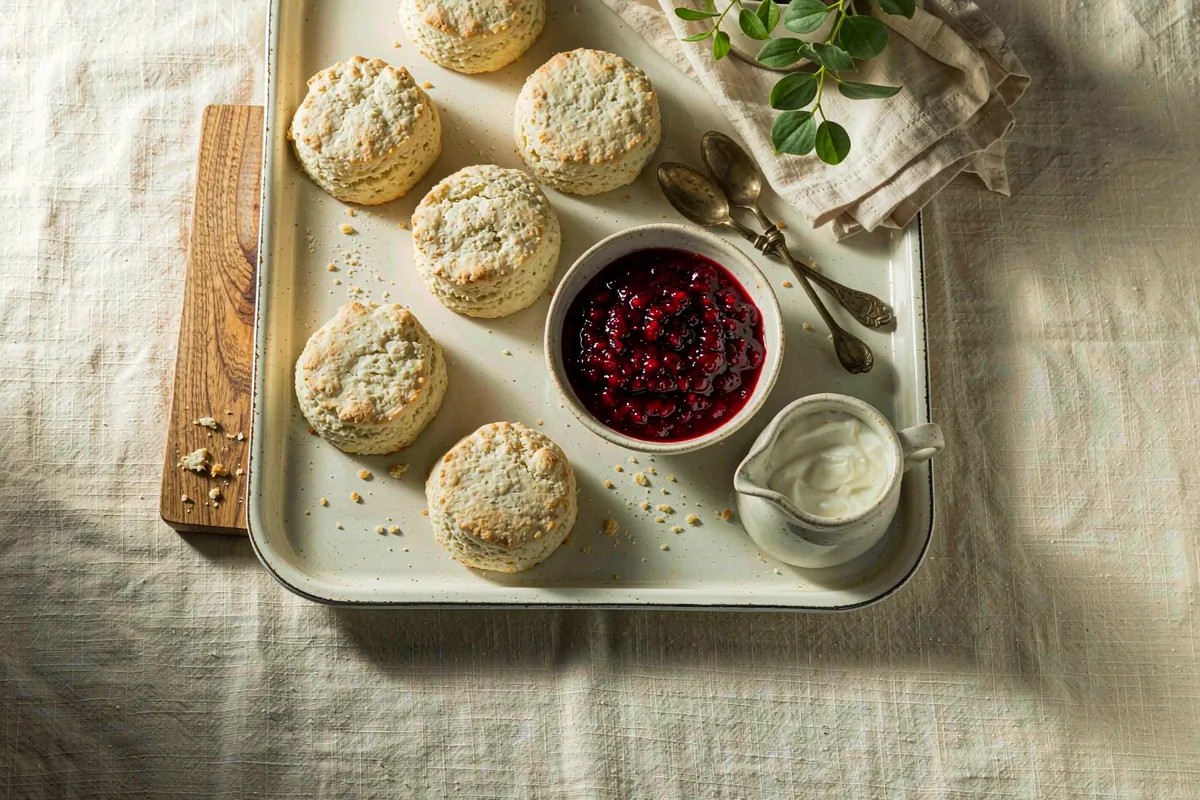
Rubbed butter, cold milk and a light hand produce tall, crumbly scones with a pale golden top and a clean split, ready for jam and thick cream within half an hour.
About this dish
Scones are won or lost in the rubbing. Cold butter should stay in visible pea-sized flecks through the flour; those little pockets melt in the oven and leave the flaky, slightly crumbly layers you can pull apart with your fingers. Handle the dough as little as possible and press straight down with the cutter rather than twisting, which seals the edges and stops the rise. The kitchen smells of warm cream and toasted wheat, and the baked tops should sound hollow when tapped.
Before you start
Equipment: Oven. Tap the ingredient checkboxes as you go.
Method
7 steps · tick each one off as you finish it.
Preheat and mix dry
Heat the oven to 220 °C and line a baking tray. Whisk 300 g flour, 2 tsp baking powder, 2 tbsp sugar and 1/4 tsp salt in a bowl for 20 seconds so the raising agent is evenly distributed.
Rub in the butter
Add 60 g cold cubed butter and rub it into the flour with your fingertips for 2 minutes. Stop when the mixture looks like coarse breadcrumbs with visible pea-sized flecks of butter still intact, not a smooth paste.
Bring it together
Pour in 150 ml cold milk and stir with a round-bladed knife for 20 seconds, just until a soft, shaggy dough forms. It should look slightly rough and hold together when pressed; stop well before it becomes smooth.
Pat and cut
Tip the dough onto a floured surface and pat it to a 3 cm thick round, handling it as little as possible. Cut 6 rounds with a 6 cm cutter, pressing straight down without twisting, and re-roll the scraps only once.
Brush and bake
Set the rounds 3 cm apart on the tray, brush the tops with 1 tbsp milk and dust with 1 tbsp sugar. Bake at 220 °C for 12 to 15 minutes, until well risen, pale golden and hollow-sounding when tapped underneath.
Cool briefly
Rest the scones on the tray for 5 minutes; the crumb sets and the steam settles. A split scone should look dry and flaky inside, with no damp dough at the centre, and the tops should keep their pale gold colour.
Serve
Serve the scones warm with 80 g thick cream and 80 g berry jam. They should pull apart with a soft crumble rather than tearing, and the kitchen should still carry a light smell of warm cream and toasted wheat.
Tips that matter
- Grate the butter straight from the fridge and chill the flour first; warm fat rubs in too far and the scones come out flat.
- Press the cutter straight down and do not twist; a twist seals the edge and stops the scone rising cleanly.
Easy variations
- Add 60 g raisins or dried currants to the dry mix for a fruit scone.
- Replace 50 g flour with cocoa and add 60 g chocolate chips for a sweet version.
Questions that come up
Why are my scones dense and heavy?
Almost always overworking the dough or old baking powder. Fold just until it comes together and check the powder is in date.
Can I freeze the dough?
Yes, freeze cut rounds on a tray, then bag them; bake from frozen at 220 °C with 3 extra minutes.
Nutrition, roughly
| Energy | 300 kcal |
|---|---|
| Protein | 6 g |
| Carbohydrate | 38 g |
| Fat | 14 g |
Estimated per serving from standard ingredients, rounded. Treat it as a guide, not clinical data.
Reading a Rising Dough Instead of a Clock
Temperature, yeast and the four signals that tell you when a loaf is ready to bake, long before the timer does.