Dumplings & Steamed Buns · Chinese home cooking
Steamed Mantou Buns
Plain wheat dough, proofed twice and steamed over gentle heat, yields tall snowy buns with a tight, springy crumb that pulls apart into soft, faintly sweet layers.
About this dish
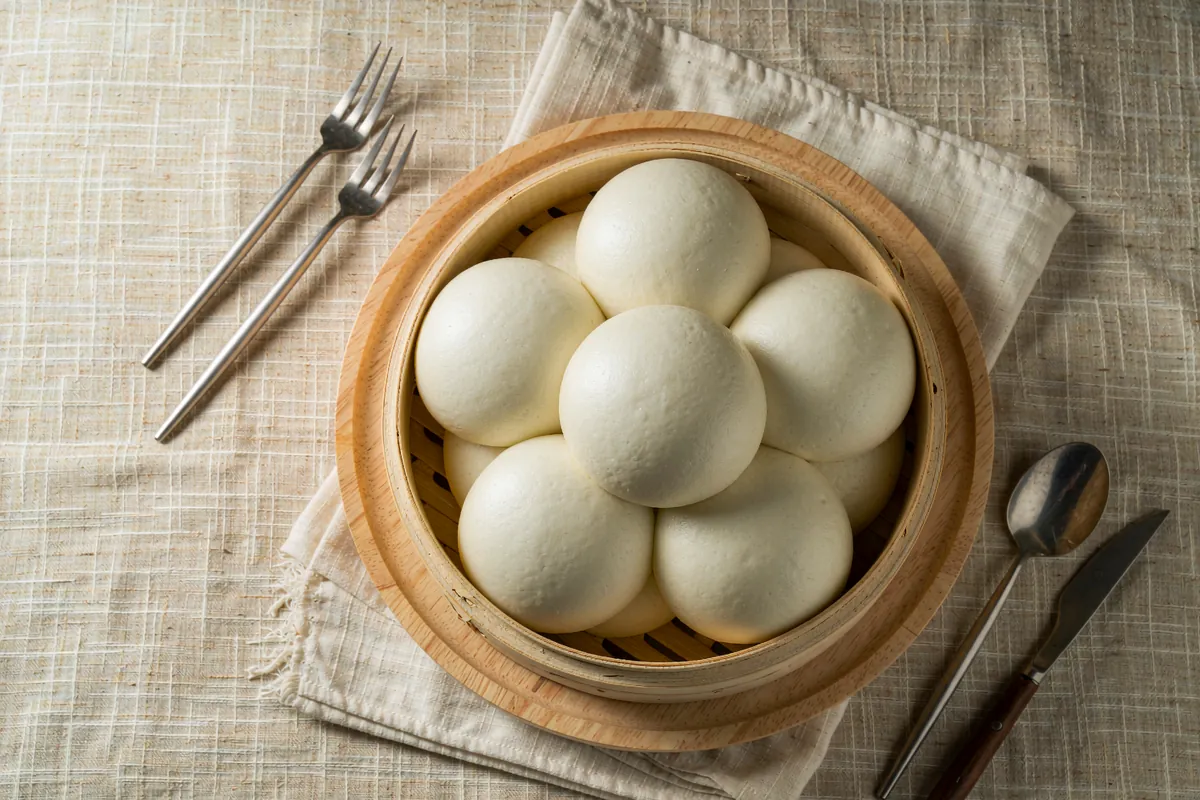
Mantou asks for almost nothing, which is why it exposes every small mistake. Flour, water, sugar and yeast have nowhere to hide, so proofing temperature and kneading decide the result. I make these on cold Sunday mornings: the dough starts cool and tacky under the palm, then warms into a smooth dome that sighs when pressed. The steamer lid rattles, a milky wheat smell fills the hallway, and the buns emerge as a pale stack with matte, uncracked skins that squeak softly when torn open.
Before you start
Equipment: Steamer, Pot. Tap the ingredient checkboxes as you go.
Method
7 steps · tick each one off as you finish it.
Wake the yeast
Whisk the lukewarm milk, sugar and yeast in a bowl and leave for 8 minutes at room temperature until a thick beige foam covers the surface. If no bubbles appear after 10 minutes the yeast is dead; start again rather than risking a dense bun.
Mix and knead
Tip in the flour, salt and oil and stir until a shaggy mass forms, about 2 minutes. Knead on a floured board for 10 minutes with the heel of your hand until the dough is smooth, elastic and pulls cleanly away from the board.
First proof
Set the dough in an oiled bowl, cover with a damp cloth and leave at 26-28 C for 60-75 minutes. It has had enough when doubled; a finger pressed 1 cm into the centre leaves a dent that fills back slowly over 4-5 seconds.
Degass, rest and divide
Punch the dough down to knock out the gas, knead 1 minute and rest 5 minutes under a cloth. Divide into 8 pieces of about 100 g each, rolling each into a tight ball with the seam pinched underneath so the top stays smooth.
Shape and second proof
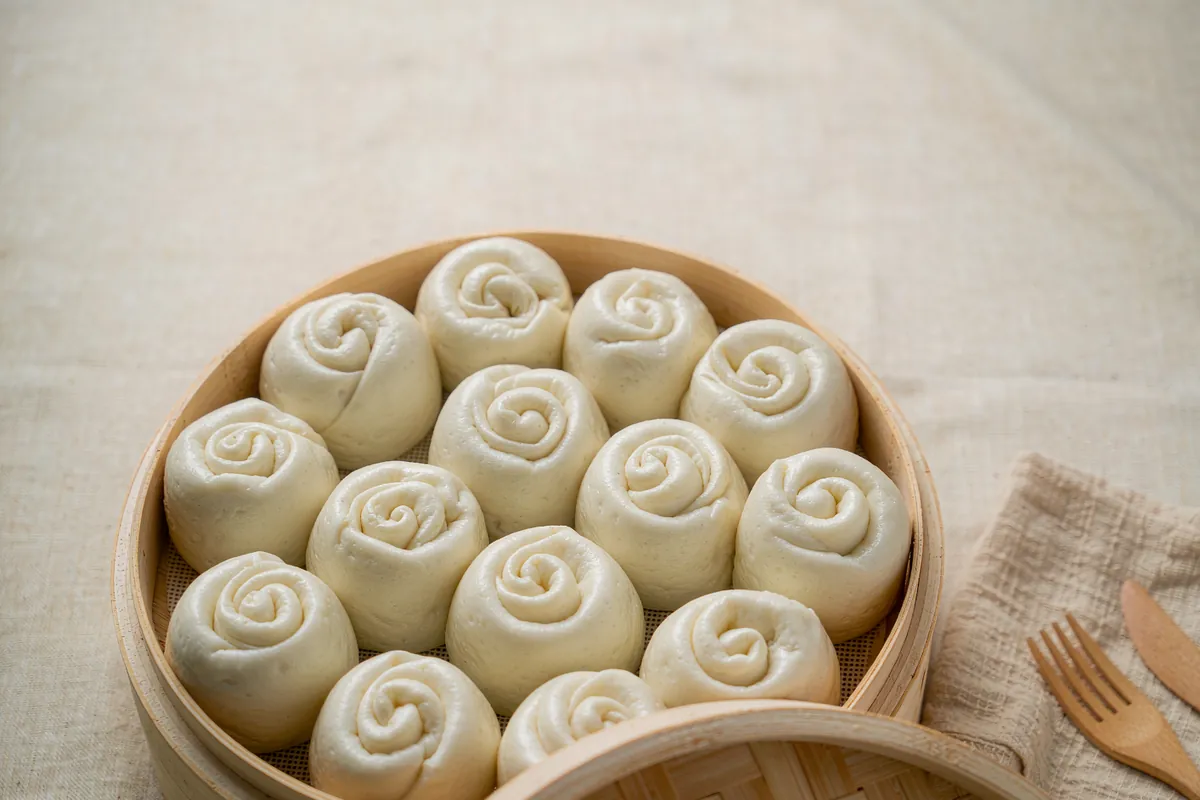
Flatten each ball into a 9 cm disc, brush the rim with cold water, then fold and roll into a short cylinder with a domed top. Set on parchment squares 5 cm apart and proof at 28 C for 25 minutes until visibly puffy.
Steam
Bring 1.5 litres of water to a full boil in the steamer base, wipe the lid with rice vinegar to stop condensation dripping, then set the buns in and steam over medium heat for 14 minutes. The buns should spring back fully when lightly pressed.
Rest before opening
Turn off the heat and leave the lid closed for 5 minutes; a sudden draught of cool air collapses the skins into wrinkles. Ease the lid open away from you, then transfer the buns to a rack so the bottoms dry rather than turning soggy.
Tips that matter
- Weigh the dough pieces instead of guessing; uneven buns finish at different times and the small ones turn dry while the large ones stay doughy in the centre.
- Stack cooled buns in a sealed bag and freeze for up to 1 month; re-steam from frozen for 8 minutes and they regain most of their soft pull.
Easy variations
- Replace 100 ml of the milk with 100 ml pumpkin puree and add 20 g more flour for a pale orange, faintly sweet loaf.
- Roll the shaped dough in 2 tbsp sesame seeds before the second proof for a nutty crust that contrasts with the soft interior.
Questions that come up
Why did my mantou collapse or wrinkle when I took off the lid?
Steam inside the bun is still setting the structure. A rush of cold air makes the skin contract faster than the crumb. Kill the heat, wait 5 minutes with the lid on, then crack it open gradually.
Can I make the dough the night before?
Yes. After the first knead, cover and refrigerate for up to 12 hours; the slow rise builds more flavour. Let it sit at room temperature for 40 minutes before dividing, or the cold dough will resist shaping.
Nutrition, roughly
| Energy | 260 kcal |
|---|---|
| Protein | 8 g |
| Carbohydrate | 52 g |
| Fat | 4 g |
Estimated per serving from standard ingredients, rounded. Treat it as a guide, not clinical data.
Flour, Water and Rest: Working with Wheat Dough
The three states of a simple dough, how hydration changes them, and why resting time is an ingredient rather than a pause.